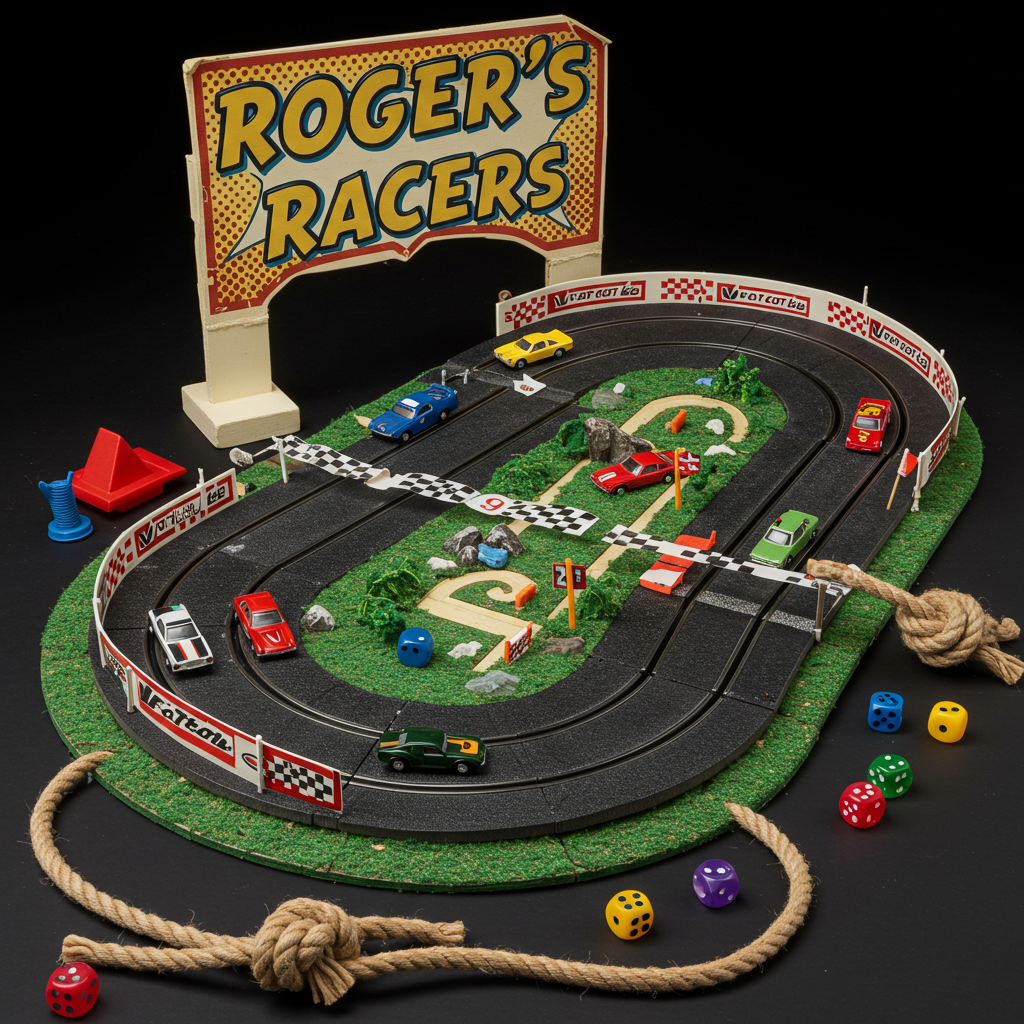

The Race Game involves drivers deciding how fast to take various curves and straights in order to safely reach the finish line first. Applying the simple probability of rolling two dice, Speed Charts are used to determine the success of those choices. Slower speeds are safer; faster speeds are riskier. The positions of the racers are determined by the cumulative score of each as added from the Speed Chart for each subsequent curve or straight. Scores are expressed in car links. The lowest score is the leader, who is placed in the area after the curve or straight. Scores are expressed in car links. The lowest score is the leader, who is placed in the area aafter the curve or straight. The car twith the second smallest score is placed behind the leader by the distance calculated by subtracting the leader score from the car being placed. For example, if the leader score is 2 1/2 and the red car is 4, the red car is 1 1/12 links behind the leader. Each following car is placed in relationship to the car in front of it by again subtracting.
The game looks and feels good. The track fits table tops and uses the included one inch cars, which are rolled through the curve or straight into position after the scpres are totaled. Then, each racer chooses the upcoming speed. The mechanics are simple. Larger cars will need much more room, and are fun for young Hot Wheels enthusiasts. Furthermore, one can create expansions, add racers, and keep records.
A one lap game takes less than a half hour and is fun for all ages old enough to not put the cars in their mounts. Score keeping does require arithmetic with fractions to the quarter. The math of scoring and dice odds can be fun.

Eight 1" Hot Wheels Carsl Two Micro Car Cases; Instruction Page; Speed Charts; Score Sheets; Printed Fabric Racetrack for 1" Cars; Dice with Bag; Ruler; Rope for Larger Track; Extra Pages
In 1969, the game began in the floor with Hot Wheels and Matchbox cars. As a twelve-year old playing at home alone, I invented a simple game that used my favorite cars in a way that I could line the, up and move them. I used a die and would move them according to the roll. When I understood the probabilities involved in using two dies, I made charts. Basically, a car that chose a safe speed would not be fast, but would be consistent with most any roll, whereas a daredevil might go very fast with a high roll or very poorly with a low roll. Eventually, I developed different charts for different curves and straights. Each of these would have six speed choices from “Safe” to “Top Speed”. The faster the speed, the risker the result. The fun continued to be lining the cars up and moving them into position bases on the results. I began to keep records and rank the cars, inventing names for drivers. By giving points to drivers who placed in races, there became season leaders.
Soon, my brother who had gone away for school began to encourage development of the game. Using the office equipment of the early 1970s, he typed and bound charts for the game. (The enclosed Speed Charts are scanned from the original charts that he made.) Often, he would mention the possibility of patenting and marketing the game. Then, I got a real driver’s license and became a real driver and got busy beyond playing in the floor.
More than fifty years later, we played the game again. The old feel of the die cast cars, rolling dice, and bantering over the results as we positioned our racers was fun. Even though this personal history adds to the importance of having this game in your collection, it is the play that makes it worthwhile. Will you speed up and hope for a good roll? What if you lead by ½ link? Will you play it safe and hope that the racer behind you rolls low? Where will you be after the curve? In the lead, behind, or crashed out of the race? What do you do in the hairpin, if you’re your four links behind? Choose your speed, roll the dice, move the cars, and watch to see who takes the lead.
A half century after the game began in the floor with Hot Wheels, it was successfully tested for new generations. Thank you, Addison, Brayden, and Goda. And, my dear brother Steve, thanks for decades of encouragement. That includes the fun hours we spent playing and assembling this heirloom edition of Roger’s Racers!
This 2025 version looks great and plays like it did generations ago. Simple mechanics with great visuals…and you still take those cool cars and line them up and move them. On the table with micro cars or in the floor with traditional cars, start your engines!
We think that you will enjoy Roger’s Racers. Share the fun, modify it, add cars… roll on!
The printed track is for one inch Hot Wheels and is make for table use. Rope is included to outline a larger setup to accommodate larger cars in the floor by using the printed track as a layout plan.
Cars are chosen and placed side by side before Curve One. Each player gets a Speed Chart. The Score Sheet is prepared by entering each car (description & driver) at the top of the column. The Score Sheet and dice are placed on the table.
Before the race begins, players should agree on the length of the race (one lap, most likely). If any expansions, such as the three-race series, are to be used, this should be discussed and be set up. Finally, racer order for the beginning should be decided. A driver with the fastest time/smallest score wins the race. A team with the most points wins.
Racer order for curve one is agreed upon by drivers. The order of play for all following curves and straights, is set by who is in lead. The leader chooses one of the six speeds from the Speed Chart, rolls the dice, and then the result is recorded on the Score Sheet. (The immediate score for that curve or straight is entered into the small box; the large box is for the cumulative score.) Then, the second place car chooses speed, rolls, and the result is recorded. And, so on. For each curve or straight, the scorekeeper announces each car’s resultant position based on the cumulative scores on the Score Sheet. Cars are then rolled along the track and positioned in relation to each other.
Positioning cars is a matter of relating each car’s cumulative score to the others. For example, if the blue car driven by N.O Nobody has a score of 10 and the yellow car driven by Bill Sniff has a 12, then the yellow car it two links behind the blue car. If N.S Sherlock in his red racer speeds through the curve and now has a total of 8 ½, he drives into position one and a half links in front of the yellow car. Usually, cars are positioned after all have scored. Cars that fall more than 10 links behind the leader are disqualified and are removed from the race.
The Speed Chart may show a letter.“O” is a crash that takes the car OUT of the race. There are other special cases, such as “C” for Crash and “S” for Spin out, which direct players to a “Special Cases” (page two of the Speed Chart) requiring an additional die roll that gives results ranging from “O” to a slight score. Handicap (+H1 or +H1/2) appears on the Special Case Crashes Chart and is only used with Pit Stop Expansion.
The fifth curve has special instructions because of the following Straight Four. If a driver chooses to take the faster speeds down the straight, then that racer must use Curve Five Star on the Speed Chart. If the safer speeds are chosen for the straight, then the safer chart, Curve Five is used. A player who chooses the faster speeds on Straight Four should have score entered in the shaded, star box and an asterisk on the total score so that it is clear that driver must use the more dangerous Curve Five Star chart.


Three-Race Series: Points are given based on finishing position. Races that reward finishing cars tend to be closer with less crashes. Players race three or four cars in three consecutive one-lap races. A great two-hour, two-player game uses four cars on each team. Passing any car from the other team matters – not just the car finishing first.
Danger Stretch Option: Adds a 1:6 chance that track conditions have changed for the upcoming curve or straight, possibly adding to drivers’ scores. Before playing each curve, two dice are rolled and the Danger Stretch Chart gives the outcome for all drivers. Cars having used a pit stop are exempt from the resulting affect.
Pit Stop Expansion: Useful for multi lap racing. Placed anywhere in the racetrack, cars may opt to enter. The Pit can remove handicaps. Also, it insures drivers from the affects of a danger stretch when it occurs. A Pit Stop chart adds to a driver’s score. The amount depends on speed choice, handicap condition, and the roll of the dice.
Source: Roger's Racers was developed and is owned by Roger P. Evans 2025